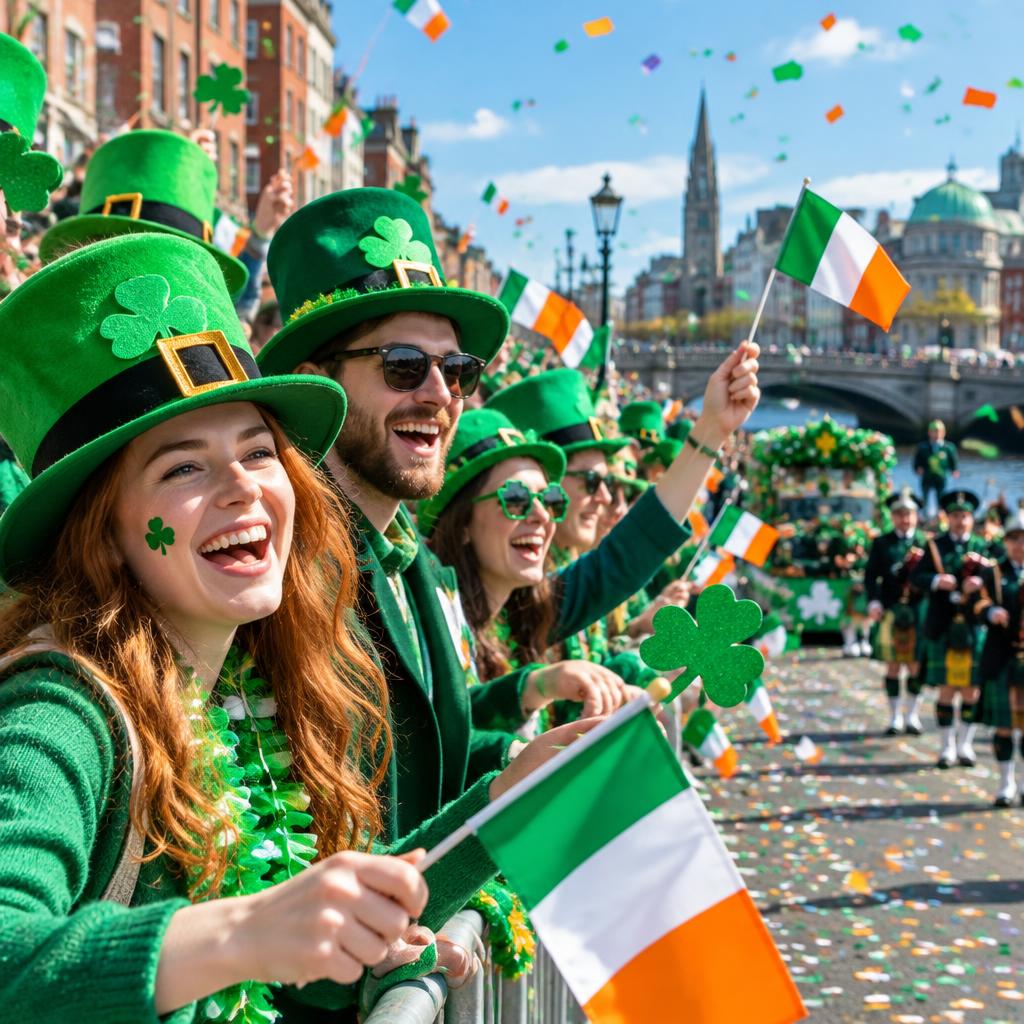
St Patrick's Day honours Ireland's patron saint and has grown into a global celebration of Irish culture, with parades, music and a sea of green.
A bit of history
Saint Patrick was a 5th-century missionary who, according to legend, used the three-leaf shamrock to explain the Holy Trinity. For centuries it was a quiet religious feast. Irish emigrants in the United States turned it into a festival of identity in the 18th and 19th centuries, and the big parades later travelled back to Dublin.
Traditions
Parades
Dublin, New York and Boston host huge parades with marching bands and floats.
Wearing green
People wear green clothes or a shamrock — legend says it makes you invisible to leprechauns.
Going green
Landmarks glow green and Chicago even dyes its river emerald.
On the table
- Irish stew
- Soda bread
- Corned beef and cabbage (in the US)
Key vocabulary
- shamrock
- a small three-leaf clover, the symbol of Ireland
- leprechaun
- a mischievous fairy from Irish folklore who hides gold
- patron saint
- a saint believed to protect a particular place or group
- parade
- a public procession through the streets to celebrate something
- the luck of the Irish
- an expression meaning very good luck
How St Patrick's Day changes from country to country
United Kingdom
A public holiday in Northern Ireland; big parties in London, Liverpool and Manchester.
Ireland
National holiday with a five-day festival and parade in Dublin.
United States
Huge parades in New York and Boston; Chicago dyes its river green.
Canada
Montreal holds one of North America's oldest parades (since 1824).
Australia
Celebrated in Irish pubs; Sydney lights the Opera House green.